
A fair day’s pay
Jamaica, Cuba, and the doctors who never got paid

If I go to the mechanic to fix my car and he fixes it and I pay him, the job is done. He or she has done the job I paid for and everyone is happy. I don’t have to go on about what a great mechanic he is, and how much he loves me as a person and looks out for my safety.
Similarly, if I go to the doctor and the doctor helps me to recover from some ailment or illness, and I pay him, I don’t have to go on about how he is such a great human being. He or she did a job, I paid him fairly for it and that is the end of that.
But what if it turns out the doctor was not fairly paid?
This is the question that lots of governments in the Caribbean are now asking themselves – especially now that the United States via Secretary of State Marco Rubio has been pointing out to them the unfairness of the Cuban overseas medical programme.
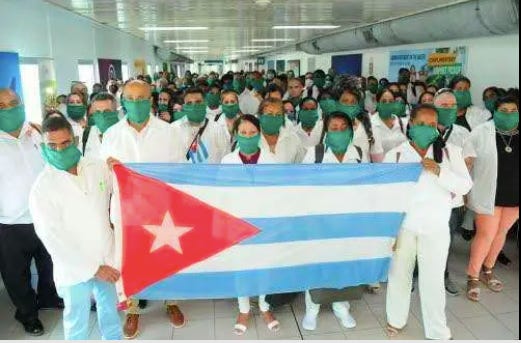
Under this programme Cuba sends doctors to Jamaica and other Caribbean islands, which helps those countries give some semblance of an efficient health system. Local doctors are few on the ground, and many go off to the metropole to make higher salaries so that they and their families can have better lives.
But these Cuban doctors, as we understand now (although many of us knew full well before, including me) were not being fairly paid or treated.
According to a press release from the Jamaican Ministry of Foreign Affairs these doctors were paid for at the same rate as Jamaican doctors in the system.
But the problem is the Cuban doctors do not get paid over that money.
The money, their salary for their hard work, is handed over to the Cuban government, which takes it all – and pays them a fragment, in keeping with the salary that they would earn in Cuba.
In Cuba the monthly salary of a doctor is about US$25 per month, (J$3,900) if they are lucky. It is one of the highest paid professions in Cuba. I am told that doctors can now earn almost double that. But J$7,800 per month is still not much – even for a Jamaican minimum wage earner.
According to a document from Jamaica’s Ministry of Finance, the annual salaries of Jamaican doctors range from a minimum of J$5.5 million for a locum intern to a high of J$10.6 m for a top-rated medical officer.
The Cuban doctor or his family will receive about US$25 per month from that salary or a total of about US$300 (J$46,000) for the year.
The Cuban doctor will also get to live in accommodation provided by the Jamaican government probably on the hospital grounds. And they will also receive a stipend, which according to the internet could equal about US$183 per month – or about J$25,000 per month.
Some would call this indentured servitude To my mind this is basically modern day slavery – where a trained doctor who has gone through med school must subsist on virtually nothing, while his government takes more than 90% of what should be his wages.
The Cuban medical programme is sold as Cuba’s great contribution to the developing world, helping poor countries to have a better health system at no expense to those countries – just out of the goodness of the hearts of the Cuban government.
The reality is that the programme is Cuba’s main way of making foreign exchange – more even than tourism – which is now in big trouble anyway, as no one who ever wants to visit the United States can now visit Cuba without running the risk of losing access to the US. American tourists even worse, as by visiting Cuba they are breaking US law.
So Cuba depends on this programme to run their economy and keep their people happy enough that they won’t consider running the risk of being imprisoned or getting shot or worse if they decide to protest in the streets.
So far the programme has worked for almost everyone involved – the Cuban government which gets FX and gets great PR, the countries receiving the doctors – many of whom they get at a discount, the patients who get medical attention which they otherwise might not get.
But the doctors don’t receive much if any benefit.
They are basically prisoners who are chained to the Cuban state.
They dare not try to seek refugee status in the US or elsewhere, because they will be labelled ‘counter-revolutionaries’ which is the worst possible thing you can be in Cuba. If they dare to do so, they will not be able to ever return to Cuba, and their families back home will be in serious trouble.
But just in case they don’t care much for their families, and just in case the idea of freedom is greater to them than the idea of remaining imprisoned in a socialist dictatorship for the rest of their lives – the Cuban government holds onto their passports at the Cuban embassy.
Nor are they allowed to freely associate with their Cuban brothers and sisters who may live in Jamaica or elsewhere.
In the case of Jamaica, that means that they cannot go to Cuban bars that may hold salsa parties in Kingston on a Saturday night. That means that they cannot go anywhere where other Cubans are likely to be. Those Cubans are also counter-revolutionaries and are therefore viewed as poison by the Cuban state. To associate with them would mean trouble for them and for their families back home.
This is the kind of society that was ended in Jamaica and other British colonies in 1834 and in Haiti in 1804. And it was supposed to have ended in Cuba in 1886 – 52 years after Jamaica.
The ruling Jamaica Labour Party (JLP) government, which stemmed from a trade union, has as one of its cornerstone tenets handed down by Sir Alexander Bustamante, the country’s first prime minister, “A fair day’s pay for a fair day’s work.”
I am not sure if the opposition Peoples National Party (PNP) - which also stemmed from a trade union - has a similar tenet, but I would expect it to.
It is unfortunate that Jamaica has had to rely on Cuban doctors to boost its health system, when those doctors are treated so unfairly.
It is also unfortunate that Jamaica has only recently seen the light about the relationship it has with these Cuban doctors and the Cuban government, and how unfairly those doctors are treated. It is surprising, since I have known about this situation for almost 20 years – so quite how this or previous Jamaican governments didn’t know baffles me quite a bit.
But Marco Rubio, who is of Cuban origin, made a point of bringing attention onto the system to Jamaica and other Caribbean governments last year. And since then, Jamaica seems to have had a bit of an epiphany.
Naturally Rubio has his own agenda, which is primarily the overthrow of the Cuban regime. But that doesn’t necessarily invalidate his views on the Cuban medical programme.
The Jamaican government says they have been negotiating with the Cuban government, to allow the Cuban doctors to be fairly paid as per Jamaican and international labour law. But that Cuba was not interested. That the agreement with Cuba ended in 2023, and that these negotiations have been going on since June.
The kind of agreement that Jamaica sought has recently been achieved by Guyana. But Cuba did not want to replicate that for Jamaica.
Why?
Because they cannot risk losing this essential FX lifeline if other countries that receive their doctors demand similar.
So the Cubans have said that as is their sovereign right that they are bringing all the doctors back to Cuba.
Jamaica has now finally taken a stand against the Cuban medical programme, which for so long many people have been duped into thinking was a programme of love and brotherhood, rather than just raw economics. Capitalism even.
Jamaica must continue to look out for its own benefit, and to seek to help the citizens of less fortunate neighbouring countries. But that does not mean assisting corrupt governments who are not interested in democracy or the freedom of their own people.
It is likely that several other Caribbean countries will follow Jamaica and Guyana, and insist on either a more fair system, or end the agreements.
I would like to end this on another tenet from Sir Bustamante, speaking about Jamaican foreign policy. I have said it before, but it bears repeating.
“We are with the West.”
To be honest, I didn’t know that this was how the Cuban doctors were being paid.
There once was a Cuban music teacher in town. I bad-mouthed communism to him, and the man unleashed on me.
Guyana was once under a form of dictatorship. I can’t begin to describe what it’s done to us, how awful it is. I for one would like to see Cubans being free, enjoying freedom.